Last week I wrote about James Clear’s (author of Atomic Habits) Habit Loop. There is a link to that article in the comments but in a nutshell the Habit Loop works like this:
Cue – the cue triggers your brain to initiate a behaviour – you see your tooth brush you realise you need to brush your teeth.
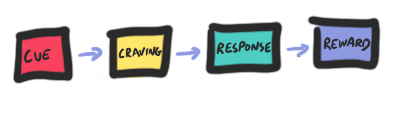
Crave – the motivation force behind every habit. What we crave is not the habit itself but the change in state it delivers – so we are not motivated to brush our teeth but by having a clean mouth.
Response – this is the actual habit you perform which could be a thought or it could be an action so we see our toothbrush, we crave a clean mouth so we respond by cleaning our teeth.
Response – this is the actual habit you perform which could be a thought or it could be an action so we see our toothbrush, we crave a clean mouth so we respond by cleaning our teeth.
Reward – the response delivers a reward – it is the end goal of every habit. Our response of brushing our teeth is rewarded instantly with a clean mouth.
When repeated often enough it becomes an automatic behaviour, a habit.
Using this knowledge James Clear created a practical framework for creating good habits and eliminating bad ones.
It is called the 4 laws of habit change.

Law 1
The habit loop starts with a CUE – so we need to make the cue for the good habit we are trying to create OBVIOUS.
Let’s say we want to create a self-care habit and we decide we want to exercise more.
To make it OBVIOUS we could get really clear on what it is we want to do, say we want to do a workout, every day for 30 minutes. The goal is clear it is obvious what we want to achieve.
Law 2
The next stage of the habit loop is CRAVING and so in law 2 we need to make our habit ATTRACTIVE or we won’t be motivated to do it.
To make it ATTRACTIVE we could go to an exercise class with friends to make it fun and to motivate each other.
Law 3
The next stage of the habit loop is RESPONSE so for law 3 we need to make it EASY otherwise we might not be able to RESPOND.
To make it EASY we could pick the same time every day to do the workout perhaps that could be before we start work in the morning. We could make it even EASIER for ourselves by leaving our clothes out the night before and putting them on first thing in the morning so we are workout ready!
Law 4
The last stage of the habit loop is REWARD so for law 4 we need to make it SATISFYING and remember with this part of the loop it needs to be INSTANTLY SATISFYING, knowing we will be fit in a few months’ time will not be instant enough to make us want to do it again tomorrow.
To make it SATISFY you might have a snack after your workout, or a warm bath, perhaps a sit down for 20 mins to relax before getting on with your day – the key is it needs to SATISFY you and so only you can decide what that is.
Breaking Bad Habits
The same framework is used to break a bad habit but this time we need to invert the loop.
Thinking about our self-care we might decide to focus on getting more sleep which can be tackled in different ways.
Maybe we realise that our social media habits are affecting the time we go to sleep and our ability to fall asleep quickly and so we might decide to stop checking social media after 9 pm each evening.
Law 1
We know stage 1 of the habit loop is the CUE so this time law 1 is to make the cue INVISIBLE.
You know what it is like you pick up your phone to check what the weather is going to be like tomorrow and before you know it you are on social media and you don’t even remember going into it.
To make the CUE INVISIBLE we could remove all the social media apps we have from our phone which would make us have to consciously and intentionally go into the internet and log into the website. Once we are doing this consciously it’s not an automatic habit and gives us more chance of stopping and making another choice that serves us better.
Law 2
The next stage is CRAVING so in law 2 we need to make what we are CRAVING UNATTRACTIVE.
To make it UNATTRACTIVE we could think about how we will feel about having spent time on social media when we didn’t want to — tired, overwhelmed, frustrated, we can think about how we will feel when we are trying to fall asleep and how we will feel in the morning if we haven’t had enough sleep, exhausted, stressed, anxious.
Law 3
The 3rd stage of the habit loop is RESPONSE so in the 3rd law we need to make it DIFFICULT to RESPOND.
Even without the apps on our phone we might realise that when we sit on the sofa in the evening we still pick up our phone and before we know it we are on the internet browsing social media sites. So we could put our phone in the garage in the evenings where it is far from our reach and we won’t pick it up out of habit. It may sound extreme to start with but remember we are looking to break the AUTOMATIC RESPONSE here.
The more steps between you and your habit the more chance you have of breaking the unconscious action.
Law 4
The final stage of the habit loop is REWARD so we need to make our habit UNSATISFYING.
We could create accountability here, we could ask our partner to point out every time we are on our phone, we could decide each evening that we go on social media after 9 pm we have to do another 10 minutes exercise tomorrow – the same as with the reward, you know yourself what will put you off the most?!
Make a plan
This framework works on any habits and behaviours in our life so let’s take overworking and see how we can create a plan to break the habit.
Make the CUE INVISIBLE
The CUE to overworking is stress, anxiety or overwhelm. So we need to remove as much stress, anxiety and overwhelm from our lives as possible. One way to do this is by creating self-care habits that enable us to relax and refresh.
CRAVING – make it UNATTRACTIVE
We could think about all of the things we are missing out on when we overwork. Maybe we don’t get as much quality time with our kids, maybe we are too tired to chat with our partner in the evening, perhaps we miss a night out with our friends, maybe we feel guilty a lot.
Pausing for a moment before we give into our craving and thinking about the consequences can help us to make different choices.
Make it DIFFICULT to RESPOND
If we are overworking at home we could put our computer and work stuff out of sight, if we are in an office we can set an app on our computer to shut down at a set time, we could delay eating dinner/snacks until we finish work so we will become hungry and uncomfortable – remember this stage is about putting as many steps in between us and our habit as possible.
REWARD – make it UNSATISFYING.
We could ask our partner, friends, family to tell us how they feel about our overworking. We can ask them to remind us of what we are missing out on. It might not be easy to hear but perhaps we need that to break the cycle. We could also review the work we have done when we overwork, what did we achieve? Consider how much impact that really had on our business and goals was it worth missing a night out our putting the kids to bed to tick a couple of unimportant things off our to do list?
We all have habits they are our system the way we live our life every day. There are many benefits to our habits but there are consequences too. The good news is we can break the habits that no longer serve us and build new ones that can transform the way we think and act everyday. It starts with a small step in the right direction, what step will you take?
If you need help with taking your first step or with any stage of your journey, why not join me for a free discovery call where you can uncover what’s really driving your habits.